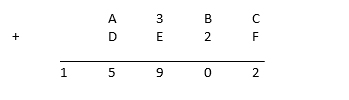
Let A3BC and DE2F be four-digit numbers where each letter represents a different digit greater than 3. If the sum of the numbers is 15902, then what is the difference between the values of A and D?
Let A3BC and DE2F be four-digit numbers where each letter represents a different digit greater than 3. If the sum of the numbers is 15902, then what is the difference between the values of A and D?
Options
a.
1
b.
2
c.
3
Correct answer
d.
4
Explanation
Each letter represents a different digit from the set {4, 5, 6, 7, 8, 9}. These digits must be greater than 3. Thus, A - D (or D - A) is to be found.
Given that C + F ends with 2, C can only be 8 or 7. If C is 8, then F is 4; if C is 7, then F is 5. Considering the carry, B + 2 + 1 must end with 0, implying B = 7. Hence, C cannot be 7, so C = 8 and F = 4.
Now, with F + 3 + 1 ending with 9, E must be 5. This results in no carry for the next term, A + D = 15, with remaining digits 9 and 6. Thus, 9 + 6 = 6 + 9 = 15.
Therefore, the difference between A and D is 3, making the correct option (c).